

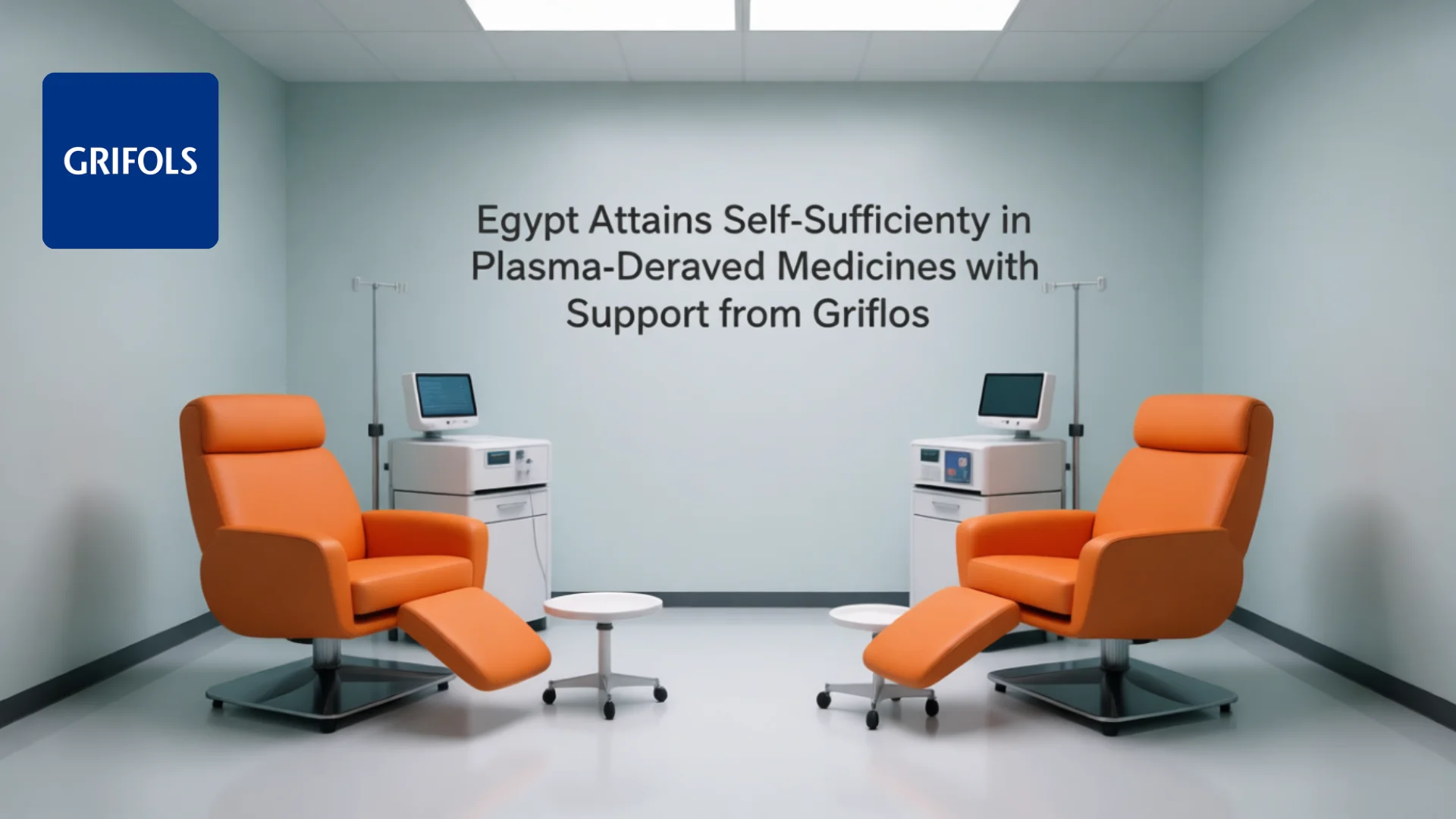
Egypt Achieves Historic Milestone in Healthcare Sovereignty: Becomes Sixth Nation to Attain Plasma Self-Sufficiency with Grifols Partnership
Plasma-derived medicines—a feat made possible through a groundbreaking five-year strategic alliance with Grifols, S.A. the global leader in plasma-derived therapies and healthcare innovation. This success marks the culmination of a visionary collaboration initiated in 2020 between the Egyptian government and Grifols, backed by a joint investment of €280 million, to establish the first end-to-end plasma ecosystem in Egypt and the broader Africa and Middle East region.
At the heart of this transformation is Grifols Egypt for Plasma Derivatives (GEPD), a public-private partnership that has not only secured a stable, domestic supply of life-saving therapies—including immunoglobulins, albumin, and coagulation factors—but has also laid the foundation for a sustainable, sovereign healthcare model. For decades, Egypt relied almost entirely on imports—primarily from the United States—for plasma-derived medicines, leaving its 115 million citizens vulnerable to global supply chain disruptions, price volatility, and geopolitical risks. This dependency was recognized by Egyptian authorities as a critical structural weakness in the nation’s healthcare infrastructure and elevated to a national strategic priority.
Now, for the first time in its history, Egypt produces and distributes essential plasma-derived medicines using domestically collected plasma, ensuring uninterrupted access for public hospitals and health centers nationwide. Over one million vials of these vital therapies—sourced entirely from Egyptian donors—have already been delivered across the country, while more than 100,000 free medical screenings have been offered to plasma donors, reinforcing a culture of voluntary, safe, and dignified donation.
Building a Sovereign Plasma Value Chain from the Ground Up
The path to self-sufficiency required more than just ambition—it demanded the construction of an entire industrial and logistical ecosystem tailored to Egypt’s unique needs and scale. Grifols, leveraging its 115-year legacy and experience managing nearly 30% of the world’s plasma supply, deployed its vertically integrated model to build every link of the value chain within Egypt’s borders.
Today, the GEPD network includes 16 state-of-the-art plasma donation centers across the country, with four additional centers scheduled to open in 2026. These facilities adhere to the highest international safety and quality standards, having passed rigorous inspections by both the Plasma Protein Therapeutics Association (PPTA) and European regulatory authorities. Complementing this donor infrastructure is a dedicated analytical laboratory and a comprehensive plasma logistics hub that ensures complete traceability from donation to final product—a hallmark of Grifols’ operations since 1971.
Perhaps the most critical component of the ecosystem is the plasma fractionation plant currently under construction in Egypt. Slated to begin operations in 2026, the plant’s first phase will enable full domestic processing of collected plasma into therapeutic proteins. This milestone will complete the sovereign loop: Egyptian donors → Egyptian collection → Egyptian processing → Egyptian patients.
Tomás Dagá, a Grifols Board Member and recently appointed Vice Chairman of GEPD’s Board, emphasized the project’s transformative impact: “Plasma self-sufficiency in Egypt is not just a logistical achievement—it’s a public health revolution. It transforms a strategic national goal into a living reality that safeguards millions of lives. Egypt’s scale, demographic weight, and geographic position make it a natural hub for the region, and we are proud to support this vision with science, investment, and long-term commitment.”
Economic Renaissance Through Healthcare Sovereignty
Beyond its health implications, the GEPD initiative is catalyzing a new era of economic development in Egypt. In 2025 alone, Grifols’ operations through GEPD are projected to contribute €55 million directly to Egypt’s GDP. By 2030, this figure is expected to exceed €272 million annually, driven by direct operations, local supplier networks, and consumer spending from newly created jobs.
The economic ripple effect is profound. Between 2026 and 2029, GEPD will invest an additional €209 million directly into the Egyptian economy. When indirect and induced impacts are factored in—including jobs created in transportation, maintenance, construction, and services—the total GDP contribution during this period is forecast to surpass €700 million.
Employment generation has been equally transformative. To date, GEPD has created 1,200 high-skilled direct jobs, supported nearly 10,150 indirect positions, and stimulated 4,200 induced jobs through household spending. Looking ahead to 2029, the project is on track to generate 186,000 new jobs—44,700 direct, 107,800 indirect, and 34,280 induced—making it one of the largest private-sector employment engines in Egypt’s healthcare and biotech sectors.
Investing in Human Capital: The Grifols Academy for Plasmapheresis
Recognizing that true self-sufficiency requires local expertise, Grifols launched the Grifols Academy for Plasmapheresis in Cairo—the first institution of its kind in Africa dedicated exclusively to plasma donation and processing training. Since its inception, the Academy has delivered over 170,000 hours of specialized instruction to Egyptian professionals, following international curricula co-designed by Grifols’ global training team.
The Academy’s programs are tailored for medical staff, laboratory technicians, logistics coordinators, and quality assurance specialists, ensuring that every layer of the plasma ecosystem is operated by locally trained, certified professionals. This model of knowledge transfer is designed not only for sustainability but also for scalability, enabling Egypt to eventually export expertise alongside its medicines.
In parallel, GEPD has forged partnerships with leading Egyptian universities to integrate plasma science into biomedical curricula, creating a pipeline of future talent capable of sustaining and expanding the national plasma industry without reliance on foreign experts.
A Regional Beacon for Health Security
Egypt’s achievement carries implications far beyond its borders. In a region where many nations remain heavily dependent on imported plasma therapies, Egypt now stands as a replicable model of health sovereignty. Once domestic demand is fully met, surplus plasma and finished products can be shared with neighboring countries in Africa and the Middle East, fostering a new paradigm of regional healthcare cooperation.
Grifols’ strategic vision positions Egypt not just as a self-sufficient nation but as a future exporter and trainer—an emerging biopharmaceutical hub bridging continents. Its geographic centrality, combined with newly acquired industrial capabilities, offers a compelling template for other governments seeking to reduce external dependencies and build resilient health systems.
To further solidify this vision, Grifols has reinforced its leadership in Egypt by appointing Tomás Dagá—architect of the GEPD roadmap since 2020—as Vice Chairman of the GEPD Board. His expanded role underscores Grifols’ long-term commitment and aligns with the company’s global strategy to promote plasma self-sufficiency as a pillar of national security.
Grifols: The Global Champion of Plasma Self-Sufficiency
Egypt joins an elite group of only five other nations—primarily in North America and Western Europe—that have achieved full plasma self-sufficiency. This exclusivity underscores the immense technical, regulatory, and financial barriers involved. Few companies possess the integrated infrastructure, scientific expertise, and long-term vision to overcome them. Grifols stands alone in this regard.
With over 400 plasma donation centers worldwide and a fully integrated supply chain—from donor recruitment to final drug formulation—Grifols has proven its unique ability to execute national self-sufficiency projects. Similar partnerships, such as its collaboration with Canadian Blood Services, demonstrate a consistent model: co-investment, knowledge transfer, and local empowerment.
In an era of increasing global demand for immunoglobulins (driven by autoimmune and neurological disorders) and albumin (used in critical care, surgery, and trauma), supply chain fragility has become a top concern for health ministries. Grifols’ self-sufficiency model directly addresses this vulnerability by anchoring production within national borders, insulating populations from external shocks.
Moreover, the social return on investment is undeniable. Independent analyses estimate that the health benefits generated by GEPD’s therapies—through earlier diagnosis, improved treatment access, and disease prevention—already exceed €80 million in societal value. When combined with job creation, GDP growth, and educational advancement, the project emerges as a holistic development engine.
A New Chapter for Egypt’s Healthcare Future
Egypt’s journey to plasma self-sufficiency is more than a medical milestone—it is a testament to what can be achieved when public vision meets private-sector capability. By transforming a strategic vulnerability into a pillar of national strength, Egypt has not only secured access to essential medicines for its citizens but has also laid the groundwork for regional leadership, economic diversification, and scientific advancement.
Grifols, as both partner and enabler, has demonstrated that healthcare sovereignty is not a distant ideal but an attainable reality. As global demand for plasma therapies continues to rise—projected to grow at over 7% annually through 2030—the Egyptian model offers a blueprint for nations worldwide.
In the words of Tomás Dagá, “This is not the end of a project. It is the beginning of a new era—one where health, industry, and national dignity converge through the power of plasma.” With its eyes now set on regional impact and future expansion, Egypt stands ready to lead the next wave of healthcare sovereignty across Africa and the Middle East.
Source Link: https://www.grifols.com/