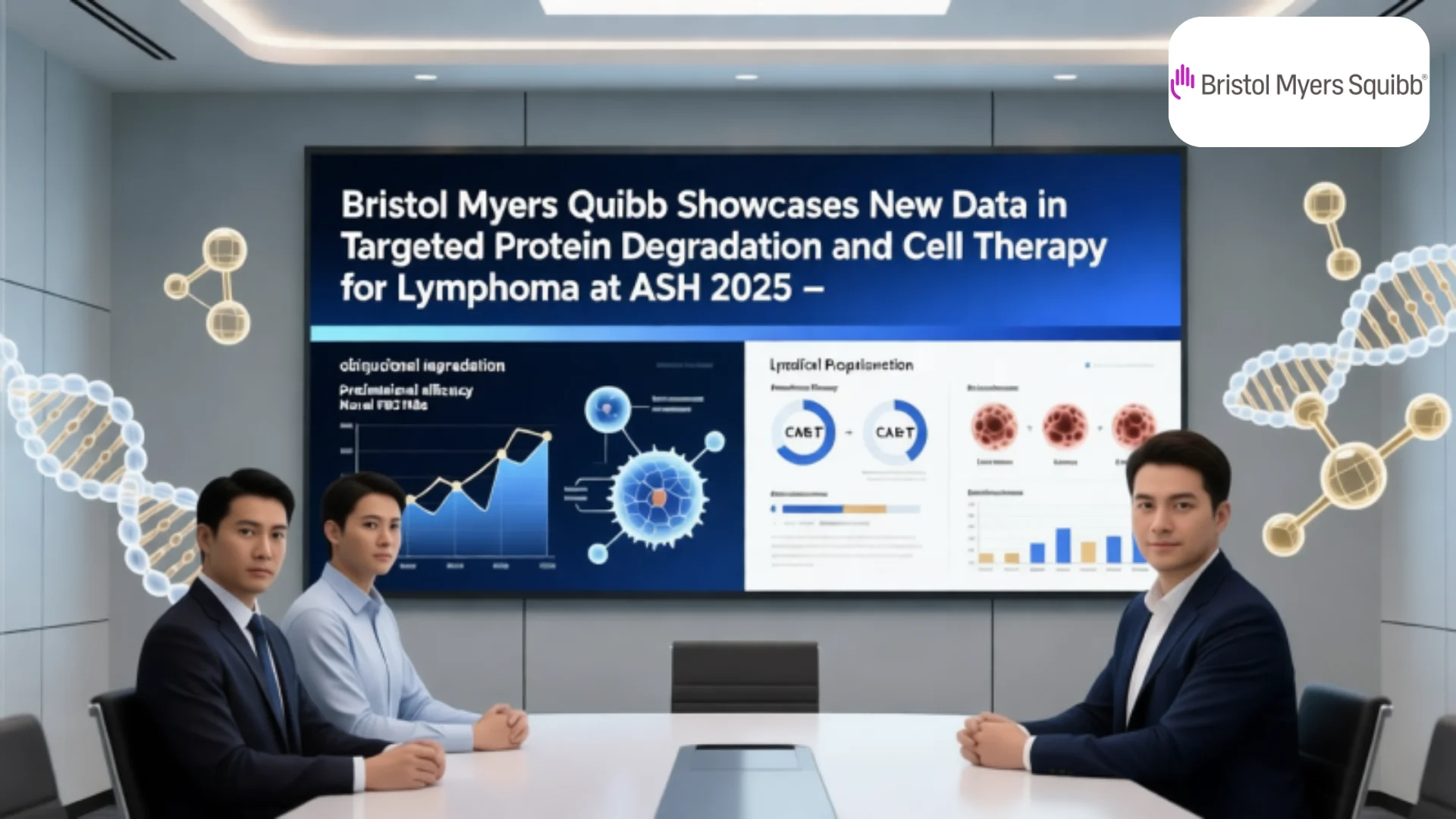
Bristol Myers Squibb reinforces its hematology leadership through new research across multiple therapies for patients with lymphoma at the 67th American Society of Hematology (ASH) Annual Meeting.
Highlights include updates from the company’s targeted protein degradation pipeline, including data on first-in-class investigational lymphoma CELMoD™ agent golcadomide and first-in-class BCL6 ligand-directed degrader BMS-986458; alongside long-term results for Breyanzi® (lisocabtagene maraleucel; liso-cel), a CD19-directed chimeric antigen receptor (CAR) T cell therapy, from the Phase 3 TRANSFORM and Phase 2 TRANSCEND FL trials.
“The data presented at ASH represent a significant step forward in our pursuit of transformative outcomes for patients with lymphoma, who urgently need more effective and durable treatment options,” said Anne Kerber, senior vice president, head of development, Hematology, Oncology and Cell Therapy, Bristol Myers Squibb. “From the potential of golcadomide to offer meaningful benefit in aggressive B-cell and follicular lymphomas, to the innovative mechanism of our BCL6 ligand-directed degrader, BMS-986458, and the proven, long-term efficacy of Breyanzi – these collective results underscore our dedication to pioneering therapies that make a real difference for patients.”
Targeted Protein Degradation
Two-year follow-up of golcadomide plus R-CHOP in patients with previously untreated aggressive B-cell lymphoma (Abstract #476): At median follow-up of 24 months, golcadomide 0.4 mg plus R-CHOP continued to demonstrate deep, durable responses and promising progression-free survival (PFS).
- PFS rate of 79% across overall and high-risk populations.
- Complete metabolic response rate (CMR) was 88% and minimal residual disease (MRD) negativity rate was 90%, irrespective of cell of origin.
- In high-risk patients, CMR was 89% and MRD negativity was 93%.
- Predictable and manageable safety was observed with no new safety signals observed.
- Data support the ongoing Phase 3 GOLSEEK-1 study in this high-risk population.
Extended follow-up of golcadomide plus rituximab in patients with relapsed or refractory follicular lymphoma (Abstract #1006) and relapsed or refractory diffuse large B-cell lymphoma (Abstract #479): Golcadomide plus Bristol Myers rituximab continued to show promising efficacy and durable responses in heavily pre-treated patients with relapsed or refractory follicular lymphoma (R/R FL) and relapsed or refractory diffuse large B-cell lymphoma (R/R DLBCL), including in those with prior T-cell redirecting therapy.
- In FL, golcadomide 0.4 mg plus rituximab showed an overall response rate (ORR) of 97% and a complete response rate (CRR) of 78%.
- In DLBCL, golcadomide 0.4 mg plus rituximab showed an ORR of 58% and a CRR of 44%.
- No new safety signals in either patient population were observed.
- Data support the ongoing Phase 3 GOLSEEK-4 study in FL who have received at least one prior line of systemic therapy.
Updated results from dose-escalation study of BMS-986458 monotherapy in heavily pre-treated relapsed or refractory non-Hodgkin lymphoma (Abstract #480): BMS-986458, an investigational ligand-directed-degrader targeting BCL6, continued to show promising preliminary efficacy and acceptable tolerability in patients with heavily pre-treated R/R DLBCL and FL, with mainly low-grade adverse events.
- Strong antitumor activity was confirmed, with an ORR of 65% (54% in DLBCL and 80% in FL) and a CRR of 21% (7% in DLBCL and 40% in FL).
- Data support continued development of BMS-986458 as a monotherapy or combination therapy for non-Hodgkin lymphoma (NHL).
“The updated data for our BCL6-targeting ligand-directed degrader reinforce the promise of ligand-directed degradation as a novel approach for patients with relapsed or refractory non-Hodgkin lymphoma,” said Michael Pourdehnad, senior vice president, head of early clinical development, Hematology, Oncology and Cell Therapy, Bristol Myers Squibb. “Seeing strong antitumor activity and meaningful responses, even in heavily pre-treated populations, underscores the potential of this mechanism to address critical unmet needs and advance the standard of care.”
Cell Therapy
Long-term follow-up results of patients treated with Breyanzi in TRANSFORM study (Abstract #3710): In a four-year follow-up, combining data from TRANSFORM and long-term follow-up (LTFU) studies, Breyanzi continued to demonstrate long-term clinical benefit with high PFS and overall survival (OS) rates in patients with second-line relapsed or refractory large B-cell lymphoma (LBCL). Upon completion of TRANSFORM, patients treated with Breyanzi could choose to enroll in a separate LTFU study.
- Median PFS (95% CI: 12.6–NR) and OS (95% CI: NR–NR) were not reached (NR).
- The four-year landmark PFS and OS rates were 52.2% (95% CI: 41.5–62.8) and 61.5% (95% CI: 51.2–71.7), respectively.
- Breyanzi continued to demonstrate a consistent safety profile with no new safety signals observed compared with previous results from TRANSFORM.
Three-year follow-up with Breyanzi in the TRANSCEND FL study (Abstract #467): Three-year follow-up results from TRANSCEND FL showed that a single infusion of Breyanzi continued to demonstrate high rates of deep and durable responses.
- Complete response (CR) rate was 94% with 70% of patients still in response at 36-months (duration of response [DOR]).
- 36-month OS was 86% and PFS was 68% in patients with third-line or later R/R FL.
- Consistently high efficacy was seen across subgroups with ORR of 96%-100% and three-year ongoing response rates of 60%-83%, including in patients with high-risk characteristics (progression of disease within 24 months (POD24), bulky disease, double-refractory disease).
- Safety was consistent with the primary and two-year follow-up analyses.
“Results from the TRANSFORM and TRANSCEND FL trials are a remarkable display of the treatment Breyanzi can provide for patients living with certain B-cell lymphomas, offering improved outcomes and consistent safety profile,” said Lynelle B. Hoch, president, Cell Therapy Organization, Bristol Myers Squibb. “
These trial results are reinforced by what we’ve seen in the real world – cell therapy continues to revolutionize the treatment of certain types of blood cancer with deep and durable responses, further inspiring us at BMS to continue driving this modality forward for patients.” Bristol Myers Squibb thanks the patients and investigators involved in these clinical trials.
About Breyanzi
Breyanzi is a CD19-directed CAR T cell therapy with a 4-1BB costimulatory domain, which enhances the expansion and persistence of the CAR T cells. Breyanzi is made from a patient’s own T cells, which are collected and genetically reengineered to become CAR T cells that are then delivered via infusion as a one-time treatment. The treatment process includes blood collection, CAR T cell creation, potential bridging therapy, lymphodepletion, administration, and side-effect monitoring.
Breyanzi is approved in the U.S. for the treatment of relapsed or refractory large B-cell lymphoma (LBCL) after at least one prior line of therapy, has received accelerated approval for the treatment of relapsed or refractory chronic lymphocytic leukemia (CLL) or small lymphocytic lymphoma (SLL) after at least two prior lines of therapy, relapsed or refractory follicular lymphoma (FL) after two or more prior lines of systemic therapy, relapsed or refractory mantle cell lymphoma (MCL) after at least two prior lines of systemic therapy, and relapsed or refractory marginal zone lymphoma (MZL) after at least two prior lines of systemic therapy.
Breyanzi is also approved in Japan, the European Union (EU), Switzerland, Israel, the United Kingdom (UK), and Canada for the treatment of relapsed or refractory LBCL after at least one prior line of therapy; in Japan for the treatment of patients with relapsed or refractory high-risk FL after one prior line of systemic therapy, and in patients with relapsed or refractory FL after two or more lines of systemic therapy; in the EU, Switzerland, Israel, and the UK for the treatment of relapsed or refractory FL after two or more lines of systemic therapy; and in the EU and Israel for the treatment of relapsed or refractory MCL after at least two lines of systemic therapy including a Bruton’s tyrosine kinase (BTK) inhibitor.
Source Link: https://investors.bms.com/